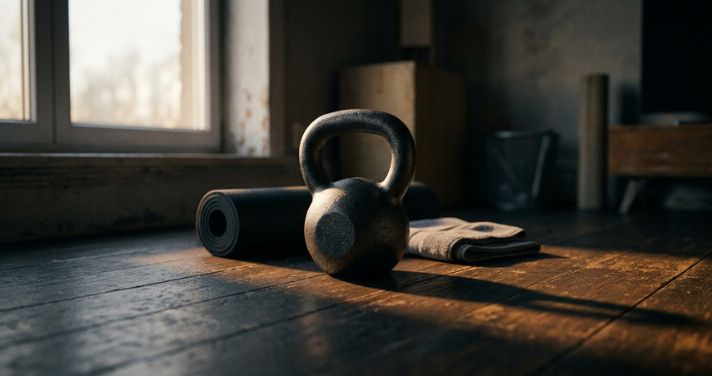
You don't need a garage full of iron to train properly. You need one kettlebell, enough floor to swing it without hitting the TV, and the willingness to stop making excuses.
A kettlebell covers almost everything: hinging, squatting, pressing, pulling, carrying and getting up off the floor. It fits under a desk. It doesn't need plates, a rack or collars. And dozens of workouts in the app need nothing else. Look at the trainer tips and you'll keep seeing the same line: use the same bell for every movement. They were built for exactly this setup.
What weight should you buy?
This is the question everyone asks, and the honest answer is: lighter than your ego wants.
Common starting points for someone who already trains a bit:
Most men:
16 kg. Stronger or experienced lifters often go 20 to 24 kg.
Most women:
8 to 12 kg. Stronger or experienced lifters often go 12 to 16 kg.
Brand new to training, or coming back after a long break:
start at the lower end.
The catch with one bell is that different moves want different weights. Swings and deadlifts can handle heavy. Presses, snatches and Turkish get-ups need lighter. If you can only buy one, buy the one you can press overhead with control for about five reps per arm. It'll feel a bit light for swings at first. That's fine. Swing it faster.
A too-heavy bell makes half the library unusable. The tips for Arnie say it plainly: one kettlebell for the whole workout, go lighter than you think.
When you're ready for a second bell, make it a heavier one for swings, goblet squats and deadlifts.
The five moves to learn first
Nearly every kettlebell workout in the app is built from these:
A hip hinge, not a squat and not a front raise. Snap the hips and let the bell float; the arms just guide it.
Hold the bell at your chest by the horns. Sit between your heels, chest tall.
Bring the bell to the rack position at your shoulder. Zip it close to your body so it lands softly instead of slamming your forearm.
From the rack, press overhead until your bicep is by your ear. Squeeze your glutes to protect your lower back.
Lie down holding the bell overhead, stand up, lie back down, without dropping it. Never rush a get-up. It's about control, not speed.
Learn these with a light bell before adding speed. If you've never swung a kettlebell, a session with a qualified coach is money well spent.
A starter week from the app
All of these need only your one bell (and some floor). Scale reps as needed; the app lets you adjust them before you start.
Day 1: Belltower Cycle.
A 12-minute AMRAP of 8 alternating clean and presses and 12 swings. Drills the two most important moves under a bit of fatigue.
Day 2: Ding Dong Spin.
An 8-minute AMRAP of Russian twists, goblet walking lunges and goblet squats. Short, legs and core.
Day 3: Simple & Sinister.
100 one-arm swings in sets of 10, then 10 get-ups. Based on Pavel Tsatsouline's well-known programme. Rest as much as you need; quality first.
Day 4: Rest, or a long walk.
Day 5: Hinge Drumbeat.
A 15-minute EMOM of 8 alternating cleans and 12 swings. The clock keeps you honest.
Day 6: Liberty Bell Marathon.
An 8-minute AMRAP of 50 m farmer carries and 10 clean and presses. A grip test.
Day 7: Rest.
Week two, try Swing Merry-Go-Round or Golden Motor. When get-ups feel smooth on both sides, Arnie is waiting.
House rules for training indoors
Clear the swing zone.
In front of you and behind you. Kettlebells don't forgive coffee tables.
Check the ceiling
before snatches and presses.
Protect the floor.
A cheap rubber mat saves tiles and neighbours.
Set your bell where you'll trip over it.
If it's in a cupboard, you won't train.
How to find your workouts
Open the workouts, select kettlebell under Equipment, and set the match to Only what I have. Bodyweight is always included, so you'll see everything you can do with one bell and your own body. Star the ones you like, and you've built a programme.
One bell. No more excuses. Find your kettlebell workouts, FATBOY.